EOR vs PEO: Key Differences
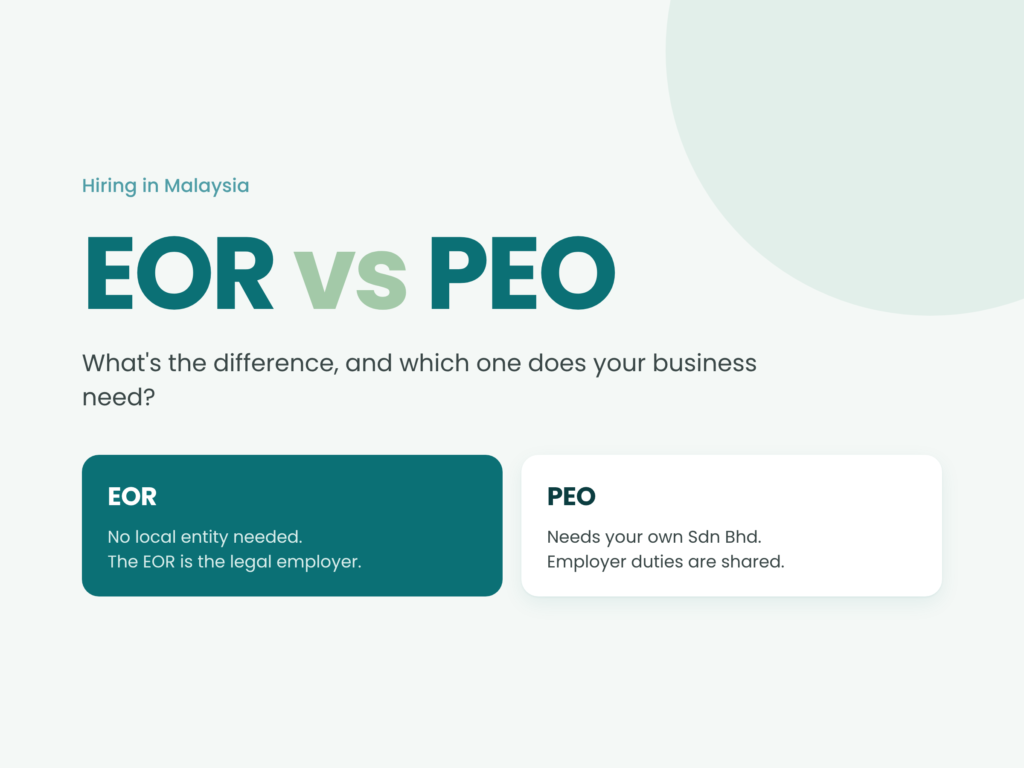
When comparing EOR vs PEO in Malaysia, the deciding question is whether you have a local entity.
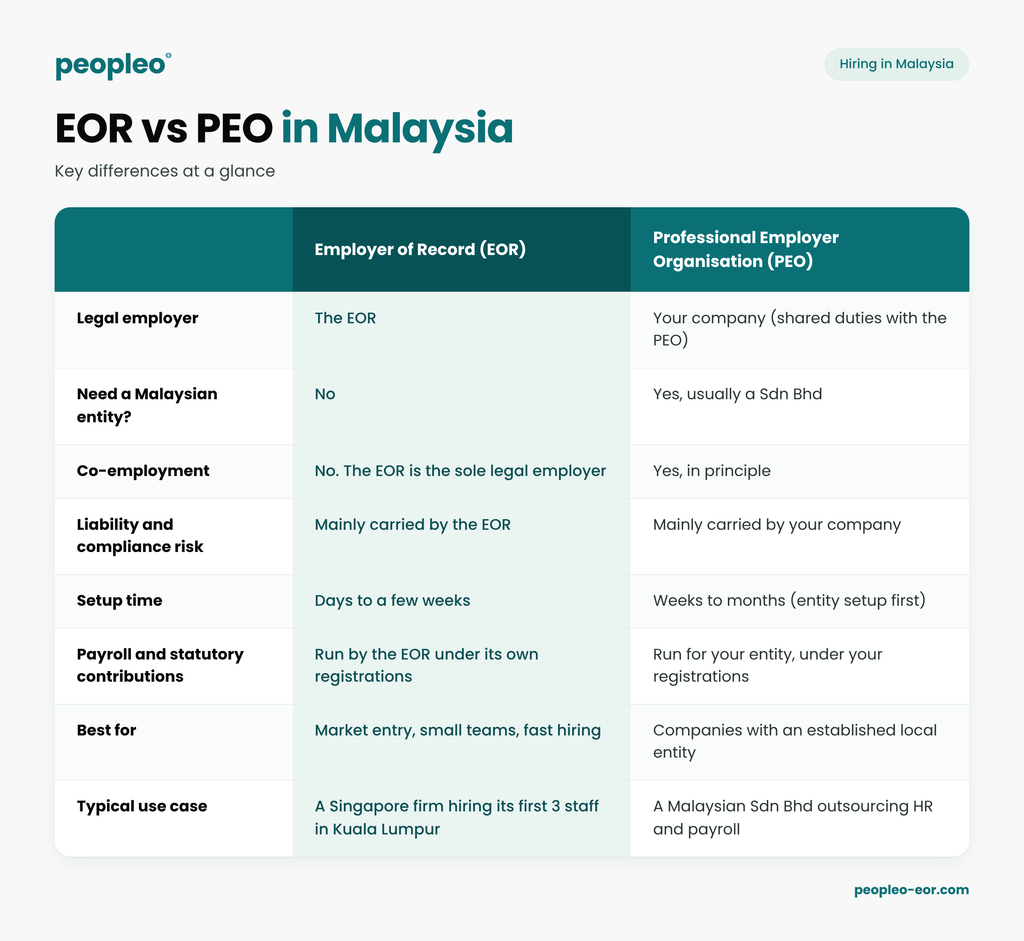
An Employer of Record (EOR) becomes the legal employer of your staff in Malaysia, so you can hire without setting up a local company. A Professional Employer Organisation (PEO) shares employer duties with you, but you must already have your own Malaysian entity.
When Should You Choose an EOR in Malaysia?
An EOR is usually the better choice when:
- You’re testing the Malaysian market and don’t want to commit to a full entity yet
- You’re hiring a small team, typically 1 to 20 employees
- You don’t have a local entity, or setting one up isn’t worth it yet
- You need to hire fast, for example to secure a candidate who has accepted your offer
- You want to avoid entity setup and running costs, such as company secretarial, accounting and audit fees
- You want compliance handled by local experts, without building an in-house HR team in Malaysia
When Does a PEO or HR Outsourcing Make More Sense?
If you already have a Sdn Bhd in Malaysia, you don’t need an EOR. In that case, payroll and HR outsourcing is usually the better fit.
This works well when:
- Your entity is set up and registered with EPF, SOCSO, EIS and LHDN
- You want to keep employees on your own payroll and contracts
- You don’t have the in-house capacity to manage payroll, statutory submissions and HR policies
- Your headcount is growing and you need structured HR support, such as handbooks, contracts and performance processes
With outsourcing, your company stays the legal employer, while the provider handles the day-to-day work accurately and on time.
Costs: EOR vs Setting Up Your Own Entity in Malaysia
Setting up your own entity in Malaysia gives you full control, but it takes time and ongoing cost. Typical steps include:
- Company incorporation with SSM (Companies Commission of Malaysia)
- Opening a corporate bank account, which can take several weeks for foreign-owned companies
- Registering with EPF, SOCSO, EIS, LHDN and HRD Corp, where applicable
- Appointing a company secretary
- Monthly bookkeeping and an annual statutory audit
- Possibly licences or minimum paid-up capital requirements, depending on your business and ownership
How Peopleo Helps
Peopleo is a Malaysia-focused EOR, payroll and HR outsourcing provider. We help companies hire in Malaysia quickly and compliantly, whatever stage they’re at.
Our approach is simple: start with EOR, move to your own entity when you’re ready, and continue with HR and payroll outsourcing. You can enter the Malaysian market without setting up a company, hire your team with fast onboarding, and keep the same trusted partner as you grow.
Our team handles employment contracts, payroll, EPF, SOCSO, EIS, PCB and day-to-day HR matters, so you can focus on building your business. Because we work only in Malaysian employment, our advice is grounded in local law and real practice.
Frequently Asked Questions
Is EOR legal in Malaysia?
Yes. An Employer of Record in Malaysia operates through a locally registered company that legally employs staff, signs compliant employment contracts, and makes all statutory contributions to EPF, SOCSO, EIS and LHDN. Choose a provider with its own Malaysian entity and a proven compliance record.
Can a foreign company hire in Malaysia without a Sdn Bhd?
Yes, through an Employer of Record. The EOR becomes the legal employer and handles contracts, payroll, statutory contributions and compliance, while you manage the employee’s daily work. This lets foreign companies hire in Malaysia without the time and cost of setting up a local entity.
What is the difference between EOR and PEO?
An EOR is the legal employer, so you don’t need a local entity. A PEO shares employer responsibilities with your company under co-employment and requires you to have your own entity. In Malaysia, co-employment isn’t formally recognised, so most providers work as an EOR or as payroll outsourcing.
Who pays EPF and SOCSO under an EOR?
The EOR registers as the employer and pays the employer’s EPF, SOCSO and EIS contributions, while also deducting the employee’s share from salary. These costs are then billed to you, the client, together with the employee’s salary and the EOR’s service fee.
Can I convert EOR employees to my own entity later?
Yes. Once your own Sdn Bhd is set up, employees can be transferred from the EOR to your entity. A good EOR provider will plan the transition with you, including new contracts, continuity of service and statutory registrations, so employees experience a smooth move.
Not sure which model fits your plans? Talk to Peopleo for a free consultation.